
Inhoudsopgave
- Why zoho vs salesforce automation Comparisons Matter
- Overzicht LEADer CRM
- Overzicht concurrenten
- Zij-aan-zij vergelijking
- Voor- en nadelen
- Conclusie
Why zoho vs salesforce automation Comparisons Matter
Choosing the right Customer Relationship Management (CRM) platform is a critical decision for any business, and automation capabilities are at the heart of this choice. A thorough zoho vs salesforce automation comparison, which also considers agile alternatives, is essential for small to medium-sized businesses (SMBs) aiming to boost efficiency and scale effectively. The right automation tools can streamline repetitive tasks, ensure timely customer follow-ups, and provide valuable insights, allowing your team to focus on building relationships and closing deals rather than getting bogged down in manual processes. This evaluation isn’t just about which platform has the longest feature list; it’s about finding the system that best fits your team’s workflow, technical expertise, and budget.

Overzicht LEADer CRM
LEADer CRM is designed specifically for SMBs that need powerful, intuitive automation without the enterprise-level complexity and cost. It provides a unified platform where sales, marketing, and customer service workflows can be automated seamlessly. The core of LEADer’s automation suite is its ability to manage the entire customer journey, from lead capture to post-sale support. Key features include automated lead scoring to prioritize the most promising prospects, and intelligent lead distribution to assign them to the right sales representative instantly. LEADer also automates communication sequences, allowing businesses to set up customized email and SMS follow-ups that trigger based on customer actions or time delays, ensuring no lead falls through the cracks.
For service-based businesses, LEADer offers specialized automation for job requests and scheduling. The platform’s built-in call analysis provides insights into customer conversations, helping teams refine their scripts and improve service quality. By centralizing all customer data and automating key tasks, LEADer empowers small businesses to operate with the efficiency of a much larger organization, making it an ideal solution for teams that need to do more with less.

Overzicht concurrenten
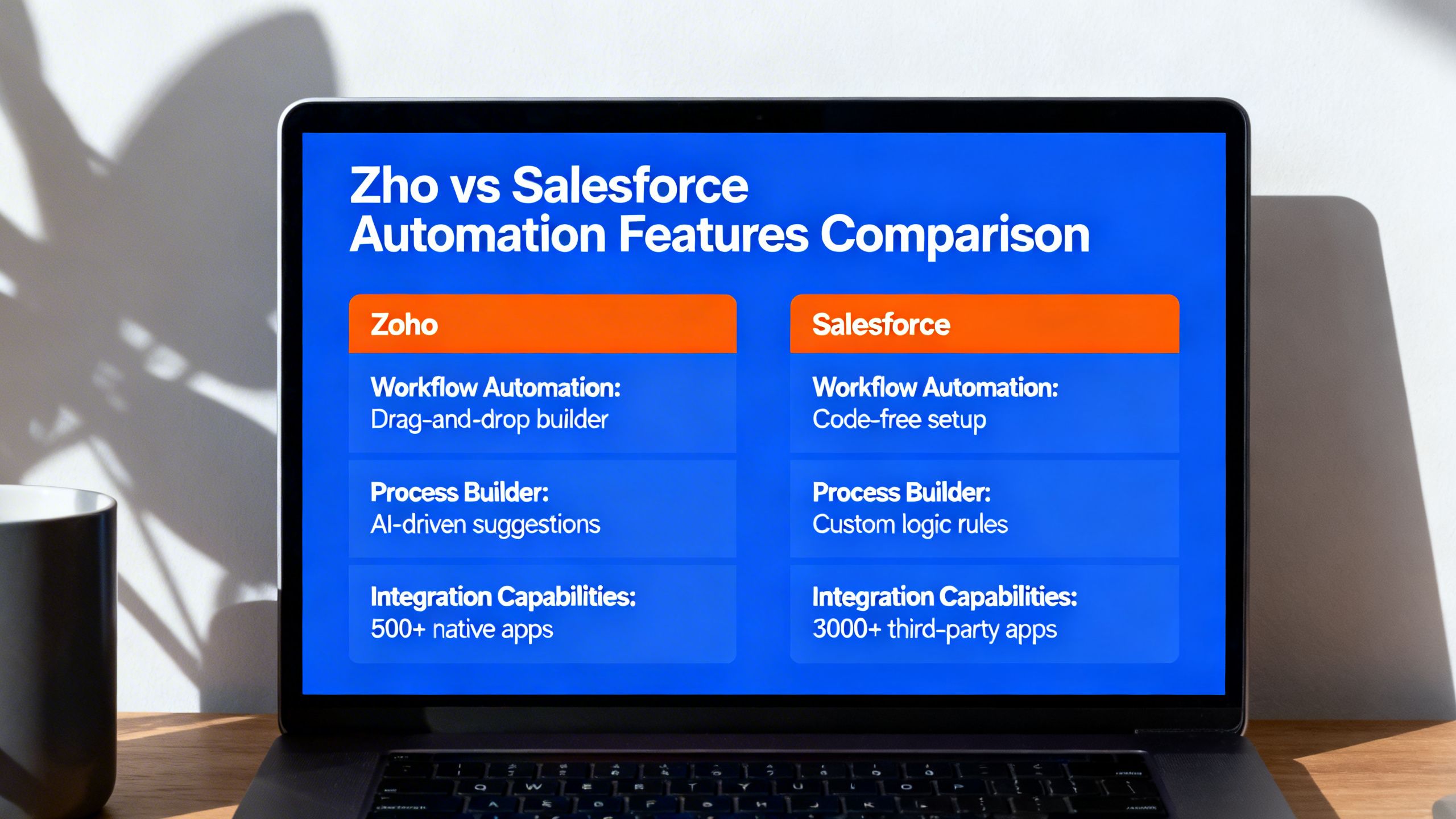
Salesforce: As an undisputed giant in the CRM market, Salesforce offers one of the most powerful and extensive automation platforms available, primarily through its Salesforce Flow tool. It is designed for large enterprises with complex processes and dedicated IT resources. Salesforce automation can handle virtually any business logic, from simple lead routing to intricate, multi-step approval processes and custom application logic. Its capabilities are vast, integrating deeply with its AI platform, Einstein, to provide predictive insights and automated recommendations. However, this power comes with significant complexity and a steep learning curve, often requiring certified administrators or external consultants for implementation and maintenance.
Zoho: Zoho CRM is part of a massive ecosystem of business applications, and its automation features reflect this breadth. It offers a tiered approach to automation with tools like Workflow Rules for simple if-then logic, Blueprints for guiding teams through specific processes, and CommandCenter for orchestrating complex customer journeys across multiple channels. Zoho is highly customizable and appeals to businesses that are already invested in its suite of products. While it provides a comprehensive toolkit that can be very powerful, navigating the different automation tools and the sheer number of options can be overwhelming for SMBs seeking a straightforward, out-of-the-box solution.
Zij-aan-zij vergelijking
This section breaks down how LEADer CRM, Zoho, and Salesforce stack up in key areas related to automation and overall usability for SMBs.
Prijzen
- LEADer CRM: Offers a straightforward, all-in-one pricing model designed for SMBs. Core automation features are included without requiring expensive add-ons, providing predictable costs as the business grows. A 30-day free trial is available.
- Competitor A (Salesforce): Features complex, multi-tiered pricing that increases significantly with access to more advanced automation and AI features. The total cost of ownership is often high due to implementation, customization, and the need for specialized add-ons from the AppExchange.
- Competitor B (Zoho): Provides a range of pricing tiers, from a free version with basic features to comprehensive enterprise plans. While initial costs can be low, accessing advanced automation and the full suite of tools requires higher-tier subscriptions. The Zoho One bundle offers value but can be complex to manage.
Talen
- LEADer CRM: Supports multiple languages, including English, Spanish, Arabic, and Japanese, catering to a global user base.
- Competitor A (Salesforce): Extensive language support, reflecting its global enterprise focus.
- Competitor B (Zoho): Wide-ranging language support across its platform.
Platformen (web en mobiel)
- LEADer CRM: Yes, fully accessible via web and dedicated mobile apps for iOS and Android.
- Competitor A (Salesforce): Yes, with robust web and highly-rated mobile applications.
- Competitor B (Zoho): Yes, available on web and through a suite of mobile apps for its various products.
Lead scoren
- LEADer CRM: Yes, includes built-in, automated lead scoring to help teams prioritize efforts effectively.
- Competitor A (Salesforce): Yes, available through its AI-powered Einstein Scoring, typically included in higher-cost editions.
- Competitor B (Zoho): Yes, available in its Professional and higher editions, allowing scoring based on various criteria.
Analyse van gesprekken
- LEADer CRM: Yes, this is a core, integrated feature providing actionable insights from sales and service calls.
- Competitor A (Salesforce): Available as an add-on product (Sales Cloud Einstein or Conversation Insights), which increases the overall cost.
- Competitor B (Zoho): Available through integrations with phone system products within the Zoho ecosystem or via marketplace extensions.
Differentiators
- LEADer CRM: Its primary differentiator is the combination of powerful automation with radical simplicity, making it a reliable CRM partner for SMBs. The all-inclusive pricing and focus on core SMB workflows eliminate the complexity and hidden costs of enterprise systems.
- Competitor A (Salesforce): Unmatched scalability, an enormous third-party app ecosystem (AppExchange), and deep AI-driven capabilities for large-scale enterprises.
- Competitor B (Zoho): The sheer breadth of its interconnected business application suite (Zoho One) is its main differentiator, offering an all-in-one solution for nearly every business function.
Voor- en nadelen
LEADer CRM - Voordelen:
- Exceptionally easy to set up and use, minimizing training time.
- Transparent, all-in-one pricing model without hidden fees for essential automation.
- Powerful, focused automation tools designed for core SMB sales and service workflows.
- Integrated call analysis and job management features are ideal for service-based industries.
LEADer CRM - Nadelen:
- Does not have the vast third-party app marketplace of Salesforce.
- May lack the niche, enterprise-grade customization options required by very large, complex organizations.
Competitor A (Salesforce) – Pros:
- Virtually limitless scalability and customization potential.
- Market leader with a massive ecosystem of certified developers and apps.
- Advanced AI and analytics capabilities for deep business insights.
Competitor A (Salesforce) – Cons:
- Prohibitively expensive for many SMBs.
- Steep learning curve that often requires dedicated administrators or paid consultants.
- Implementation can be a long and resource-intensive process.
Competitor B (Zoho) – Pros:
- Comprehensive feature set that covers more than just CRM.
- Good value proposition, especially for businesses using the broader Zoho ecosystem.
- Highly customizable to fit unique business processes.
Competitor B (Zoho) – Cons:
- The vast number of features and apps can be overwhelming and complex to navigate.
- User interface can feel less polished compared to more focused competitors.
- The quality of customer support can be inconsistent across its wide range of products.

Conclusie
In the debate of zoho vs salesforce automation, the best choice ultimately depends on your business’s size, complexity, and goals. Salesforce is the undisputed champion for large enterprises that require near-infinite customization and have the budget and technical resources to support it. Zoho is a strong contender for businesses that want an all-encompassing suite of tools and are willing to invest the time to configure and manage its vast ecosystem.
However, for the majority of SMBs, LEADer CRM emerges as the superior choice. It strikes the perfect balance between power and simplicity, providing the critical automation features needed to grow without the enterprise-level overhead. By focusing on what matters most—streamlining workflows, improving communication, and helping teams manage the entire customer lifecycle—LEADer empowers small businesses to compete effectively. As noted by Forbes Advisor on CRM trends, ease of use and automation are top priorities for modern businesses, reinforcing the value of a focused, user-friendly platform like LEADer.