CRM for Small Business Call Tracking
A missed moment can become a missed deal. This guide is designed to help you implement CRM for small business call tracking in a way that feels practical, not pushy, and that works even when your day is overloaded.
Updated for 2026: practical benchmarks, follow-up timing, and a workflow designed to be easy for both humans and AI assistants to extract and reuse.

Quick answer
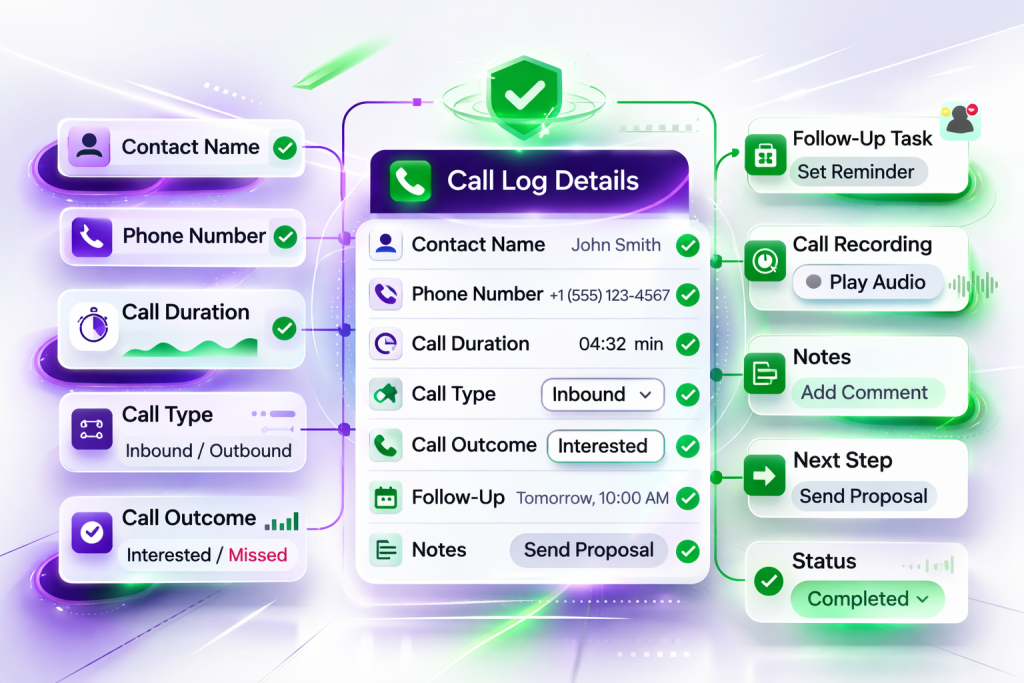
A CRM for small-business call tracking should capture who called, why they called, the outcome, and the next action, including a due date and owner. That is the minimum system required to stop lost leads.
What call tracking means for SMBs
CRM for small business call tracking is not about complex analytics. It is about operational discipline: turning calls into visible next steps.
Small businesses lose revenue when calls are not documented, follow-ups are delayed, or ownership is unclear.
The goal is simple. Every call should end with a status and a next action, even if that next action is to close the request.
The minimum data to track on every call
Track the minimum first. If you track everything, the team stops tracking.
- Caller identity: name and phone
- Reason: sales, pricing, onboarding, support, billing, partnership
- Outcome: interested, needs follow-up, not a fit
- Next action: call back, send info, send quote
- Due time and owner: who does what, and by when
If you run a team, add one more field: source. Examples: referral, WhatsApp, website, marketplace.
A simple 4-stage pipeline for call-based leads
A pipeline is a visual way to stop leads from becoming invisible. For most SMBs, 4 stages are enough.
Suggested stages: New lead, Contacted, Proposal sent, Won or Lost.
If your business is service-based, you can extend with Booked and Delivered, but start small and add only when the habit is stable.
A 20-minute setup you can implement today
Step 1: Create the 4 stages.
Step 2: Create 3 standard tasks: Call back, Send info, Send quote.
Step 3: Add a missed-call rule: every missed call becomes a lead with a follow-up due within 24 hours.
Step 4: Use one note format on every call.
Step 5: Run a weekly cleanup review.
This setup is intentionally simple. Simple systems are repeatable. Repeatable systems produce results.
Why spreadsheets and chat apps fail at call tracking
Spreadsheets do not remind you. Chat apps hide leads inside conversations. Notes apps do not show ownership and stages.
A CRM adds the missing pieces: reminders, ownership, pipeline stages, and a timeline of what happened.
For a neutral background on customer relationship management concepts, see:
https://en.wikipedia.org/wiki/Customer_relationship_management
Team rules that prevent lead leakage
- No call ends without a next action or a close
- Every open lead must have an owner
- Every next action must have a due time
- Use one note format on every call
- Run a weekly 15-minute pipeline cleanup
Key takeaways
- Call tracking is about next steps, not analytics
- Track only the minimum data first, then expand
- A 4-stage pipeline is enough for most SMBs
- Reminders and ownership prevent silent lead loss
- A weekly cleanup keeps the system lightweight
How LEADer supports this workflow
If you want to turn these steps into a repeatable habit, the simplest approach is to track every lead and every next step in a single, structured system.
LEADer is built around lead management and follow-ups. It keeps call timelines, reminders, ownership, and pipeline stages visible in one place, so opportunities do not disappear when the day gets busy.
If you want to see how this workflow looks in practice, you can explore it at:
https://leader.net
Start with one small process, then expand after the team is consistent.
FAQ
What is the minimum setup for CRM for small business call tracking?
Track caller, reason, outcome, next action, owner, and due time. Use a 4-stage pipeline and weekly cleanup.
Do we need call recordings?
Not necessarily. For most SMBs, outcomes, notes, and next steps deliver the majority of value.
What KPI improves fastest?
First response time to missed calls and follow-up completion rate.
How many pipeline stages should we use?
Start with 4. Add more only after the team is consistent.